The “AI-Native” Shift: Why Adding a Chatbot Isn’t Enough in 2026

Sreejith Madhavan
I met one of my old friends who is running a product company successfully for the last 10 years. He has multiple products which are built around open source e-commerce platforms, and it is very successful. During the conversation, he mentioned that,
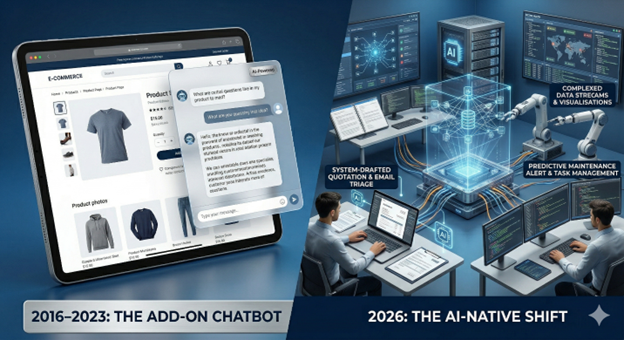
“Do you know, we AI enabled all our products in the last six months?”
I said, “Wow, that was quick. How did you do it?”
“We added an AI-enabled chatbot, now it will take care of all the primary questions from customers, and also added a powerful search.”
I paused for a while and thought, okay, here we go again.
This is happening everywhere. Add a chatbot or search and put “AI Powered” on the website, announce digital transformation with AI enablement. Good, but not enough.
The chatbot era was there 10 years back and it is still relevant, the only difference is that generative AI made it very simple. You train your model with FAQs, add a chatbot, and then announce “AI Adoption”, or add a semantic search on the website which can return results even if the user didn’t type an exact match. These are really useful features for your web application, but calling it “AI Transformation” is like buying a calculator and saying that now you are running a finance department.
There is a shift happening now.
The conversation is different now, the smarter companies are asking better questions now: “What if AI was part of the system? Can AI change the way users interact with the application? Can this be improved?”
Customers do not want an AI system sitting at the corner of your application waiting for prompts, they want it to help the work move forward. They don’t want the AI just to answer questions, rather they want it to do small pieces of work or change the way the system currently works.
How it looks like
Let me explain it with an example, what happens inside most companies every day.
Email arrives.
Data is copied into the system.
Tasks get created.
Meetings are scheduled.
Someone forgets something, someone reminds it.
Repeat every day.
These are repeatable, predictable things, and these are something AI can help with. This is where AI agents come in. Chatbots are not made for these.
Another example.
A customer sends an email: “Can you send a quotation for the below items?” Someone reads the email, opens the CRM system, creates an entry, assigns it as a task to someone. 30 minutes later, the actual work begins where a person checks the CRM, tries to find items, prepares the quotation, and sends it to the customer. All this takes around one to two hours.
Now imagine if this was an AI-native system?
The system reads the email, creates the record, fetches the details required from the CRM, prepares multiple quotations, checks the salesperson’s availability, assigns the task to the salesperson with the created quotations. The salesperson checks the quotations, selects the suitable one, makes any modifications required, and sends it to the customer. All this happens in 10 to 20 minutes. Now the productivity of the salesperson improves from attending one task in two hours to four to five tasks in two hours.
Re-imagine AI as a co-worker
Now think about the chatbot in a different way. Instead of answering questions from customers, what if it can help the employees of an organization as a co-worker? What if it can remind you, “Hey, this task is pending for you”, “I have prepared a draft reply for this email”, “Looks like this customer needs follow-up”, only assistance with no drama.
The Real Benefits
The real value of AI isn’t answering questions, it’s removing the small repetitive work and in this way improving productivity. Updating systems, tracking tasks, sending reminders, these kinds of tasks drain time and energy.
When AI handles that, people get more time to do productive work like thinking, solving problems, and serving customers.
Adding a chatbot is easy, anyone can do that.
But designing applications where AI quietly helps work move fast and in more productive ways, that’s the real shift happening now.
“We are only at the beginning of it!”
We can help!
Mercedes Benz Engine In A Second Hand 15-year-old Economic Car
#Artificialintelligence

One Functional Prototype Is Better Than A Thousand Wireframes
#Artificialintelligence
Unlocking The Potential Of Ai In Business Process Outsourcing
#Artificialintelligence
